CLOSE

Clients

Dsqueared 2
ColdCulture
Marni
Levis
Fila
Narsissist
Loreal
Maybelline
Madrid Fashion Week
Scuffers

Art & Design Productions

Hairstyling Design for Daisy Tour Rusowsky, 2025
HairDesign for Dimoni Studio in Fashion Week, 2025
ZEID Fest, Identity&Merch Design, 2023
Artefacto x Snap! Club! Club!, Identity&Merch, 2022
The Eco Lab (Identity & Web Design), 2021
Pastillas Rosas, Cover, 2020
ZETAK (Identity & Merch), 2019
Airu (Identity & Merch), 2019
Sopadevodka (Identity), 2019

Magazines

King Kong
Acero Magazine
Metal Magazine
Vogue
Bazaar
Office Magazine
Boycott Magazine
Forbes
Vanidad

Exhibitions

Bate Social Store (Madrid, 2025)
Casa Antillón (Madrid, 2023)
Kaleartean (Basuri, 2019)
Cosmos (Bilbao, 2019)
Conde Duque, diseñar para lo público (Madrid, 2019)
Arteshop (Bilbao, 2016-2018)

Artists

Rosalía
Ralphie Choo
Rojuu
Rusowsky
M.I.A
Yung Lean
Judeline
La Zowi
Lzaro
Natalia Lacunza
BB Trickz
Amore

CLOSE
Hairstylist and Visual Artist
based in Madrid


For any inquieres gorkalarcan@gmail.com

Gorka Larcan is a versatile visual artist and designer from the Basque Country. He studied Creation and Design at the University of the Basque Country and a Master's Degree in Teaching Artistic Education. Later, he completed his education with a Higher Technical Certificate in Hairstyling & Hairdressing.
He began his career in graphic design and has since expanded his creative pursuits to include hairstyling and various forms of visual art. Larcan's work often explores the cultural significance of hair and its impact on identity and perception. Known for his avant-garde cuts and experimental style, Larcan challenges conventions while honoring tradition, turning each look into a powerful statement of identity, transformation, and art.

Back to works

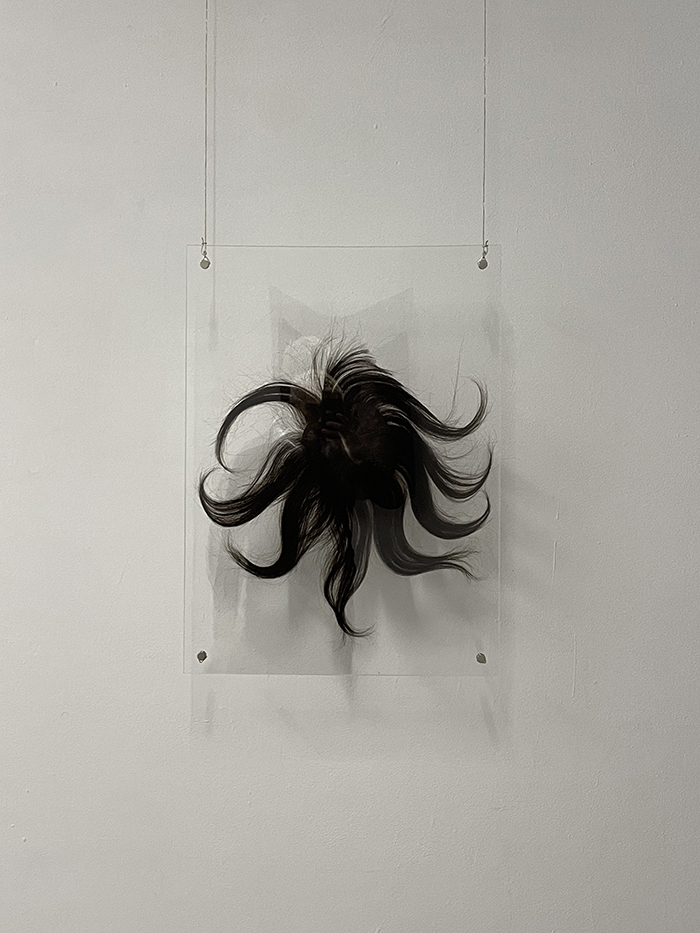
Abertzale I , 2023

Natural hair through the glass

This work explores the decontextualization of hair through the isolated image of the wig. By removing hair from the body it belongs to, the piece transforms it into an autonomous form, detached from personal identity yet still charged with cultural meaning.

The mullet haircut, widely worn among Basque youth, becomes a central reference point. Its visibility increased significantly through photographs of political prisoners, which contributed to its strong association with the visual and social identity of the Basque Country. In this way, the hairstyle is not neutral; it carries layers of history, politics, and collective memory.

By extracting the hairstyle from the individual, these pieces shift the focus from person to sign. The absence of the body allows the hair to operate as a fragmentary portrait—one that invites the viewer to imagine figures, identities, and narratives from a single visual element.

In doing so, the work questions how identity is constructed and recognized, and how something as seemingly simple as a haircut can function as a coded surface for cultural, political, and emotional projections.