CLOSE

Clients

Dsqueared 2
ColdCulture
Marni
Levis
Fila
Narsissist
Loreal
Maybelline
Madrid Fashion Week
Scuffers

Art & Design Productions

Hairstyling Design for Daisy Tour Rusowsky, 2025
HairDesign for Dimoni Studio in Fashion Week, 2025
ZEID Fest, Identity&Merch Design, 2023
Artefacto x Snap! Club! Club!, Identity&Merch, 2022
The Eco Lab (Identity & Web Design), 2021
Pastillas Rosas, Cover, 2020
ZETAK (Identity & Merch), 2019
Airu (Identity & Merch), 2019
Sopadevodka (Identity), 2019

Magazines

King Kong
Acero Magazine
Metal Magazine
Vogue
Bazaar
Office Magazine
Boycott Magazine
Forbes
Vanidad

Exhibitions

Bate Social Store (Madrid, 2025)
Casa Antillón (Madrid, 2023)
Kaleartean (Basuri, 2019)
Cosmos (Bilbao, 2019)
Conde Duque, diseñar para lo público (Madrid, 2019)
Arteshop (Bilbao, 2016-2018)

Artists

Rosalía
Ralphie Choo
Rojuu
Rusowsky
M.I.A
Yung Lean
Judeline
La Zowi
Lzaro
Natalia Lacunza
BB Trickz
Amore

CLOSE
Hairstylist and Visual Artist
based in Madrid


For any inquieres gorkalarcan@gmail.com

Gorka Larcan is a versatile visual artist and designer from the Basque Country. He studied Creation and Design at the University of the Basque Country and a Master's Degree in Teaching Artistic Education. Later, he completed his education with a Higher Technical Certificate in Hairstyling & Hairdressing.
He began his career in graphic design and has since expanded his creative pursuits to include hairstyling and various forms of visual art. Larcan's work often explores the cultural significance of hair and its impact on identity and perception. Known for his avant-garde cuts and experimental style, Larcan challenges conventions while honoring tradition, turning each look into a powerful statement of identity, transformation, and art.

Back to works

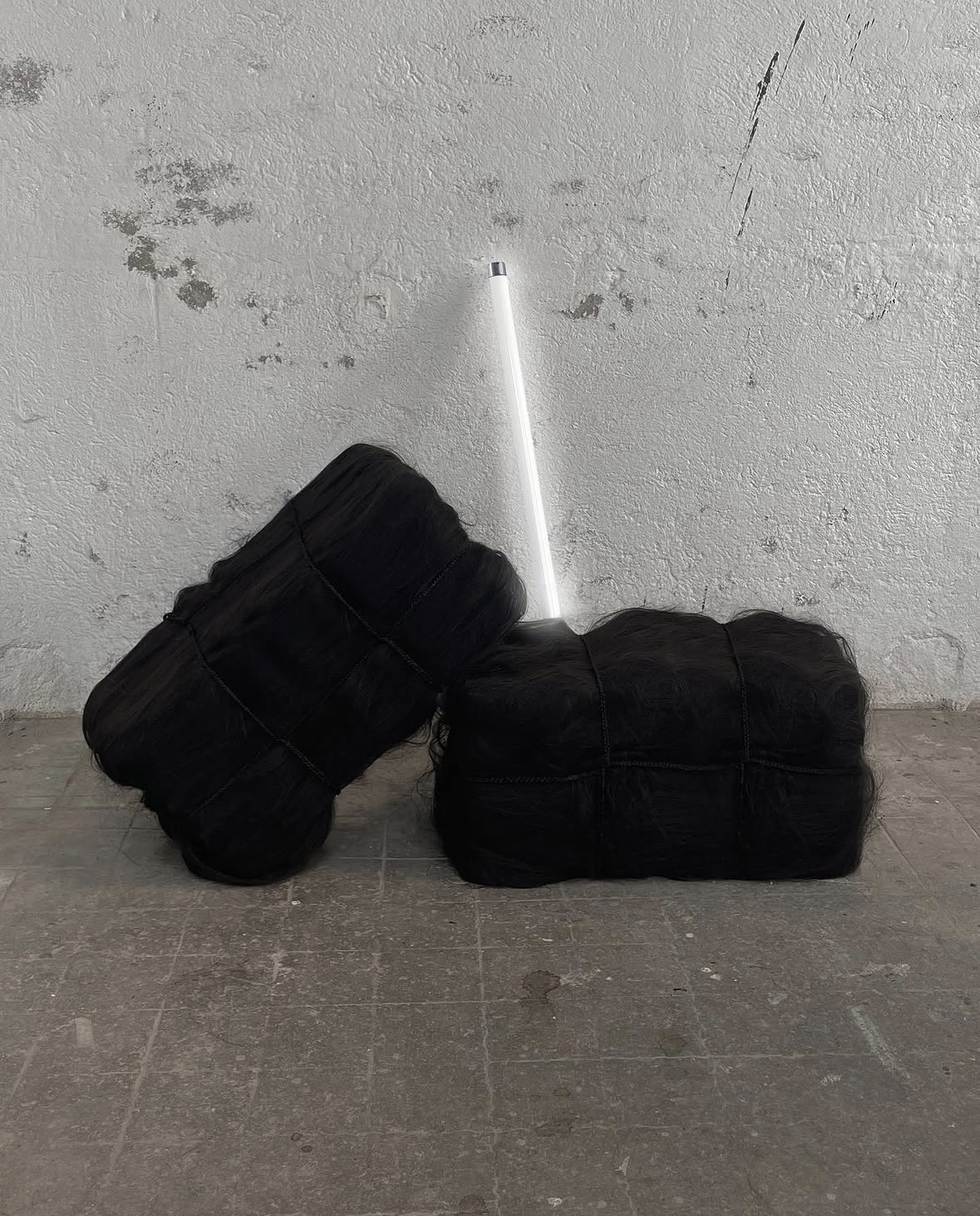
Kuboak , 2023

Hair pieces.
150x50x50 cms.

Kuboak originates from an action as simple as sweeping freshly cut hair. The traces left behind gradually form a mass of tangled hair, creating a kind of fabric that resembles felt. This process brings me back to the Basque landscape and to memories of the caserío (traditional Basque farmhouse), where bales of hay were a defining presence.

Collecting these traces and transforming them into volumes becomes an act of reconstruction. Materials that may appear simple and innocent possess a natural attraction that should be acknowledged and respected for what they represent. Hair should likewise be understood as a material in its own right—a material capable of embodying different attitudes, approaches, and emotions. In this way, it acquires a symbolic value for me, establishing a relationship that continues to fascinate and captivate.